The perks of fishing

Red_winged_blackbird_-_natures_picsIf you would characterize yourself as someone who “likes to fish,” then I feel confident that some other generalizations also hold true for you.
1. In any given week between the months of April and November (maybe a little earlier or a little later, depending upon how far north or south you live), you will contemplate the weather and gauge how good the fishing might be on at least four out of seven days.

2.  If you travel to any place within sight of a lake, stream, river, ocean or canal (especially a canal), you will wish you could fish it, except you are actually there for a family reunion, or for a wedding or because there is an adjacent B&B that’s charming the pants off your spouse. Depending upon your level of audacity, aka shamelessness, you might even drop a few bucks on a cheap rig, “Just to toss something out there, honest to God, honey.”

3. You are a nature nut.

Given that fishing is exclusively an outdoor activity (as far as I know), an outing at the ol’ fishing hole assures that you will be up to your ears in nature in all her wet, cold, sweltering (and yes) magnificent glory.

As you well know, our pursuit of piscine quarry generally features intervals that can best be defined as “between bites.”  In a given fishing outing, these intervals can range anywhere from five minutes to the entire outing.  Whether your wading in the water,  sitting in a boat or working the shore, you will be in the very heart of our planet’s richest ecosystem — the convergence of land and water.

Have you ever fruitlessly pounded the water to the point that you just want to put your rod aside and take a seat?t one step further:  Assuming the ground is dry, have you ever been tempted to actually lay down, close your eyes and lose yourself to the burbling of water over rocks, the rustling of leaves in the trees, the rusty-hinge music of a red wing blackbird? Have you ever felt so at peace?

In my younger years, I consumed huge chunks of time sitting on the bank of a lake or river eyeing a red-and-white float bobbing in the current. On those occasions when”the bite was off,” so to speak, the lengthy, uninterrupted surveillance of an apathetic float could lead to weird trains of thought, like, “This is the world in entropy. Brown water. Empty sky. The last, feeble cry of humanity can be symbolized by the dead worm dangling limply on a hook, submerged in the infinite, algae-coated void.”

What inevitably nipped those bleak musings in the bud was my dawning realization that by virtue of having sat still and kept quiet for an extended period of  time, nature had ceased regarding me as an intruder and was now operating at full throttle. I have watched a pair of muskrats repairing their lodge while their children romped and wrestled with each other. I have watched a kingfisher crash dive into the water and emerge with a six-inch bullhead squirming in its beak. I can’t tell you how many times I have observed great blue herons moving with excruciating stealth among the lily pads, or how many times I’ve tried to get visual sightings of songbirds singing in surrounding trees, or spot woodpeckers drumming overhead.

In my early teen years, blissfully unaware that undiagnosed ADHD was at the controls, I would devise “outside-the-box” techniques for catching critters. For instance, I would tie a plastic worm to the end of my line and flip it in the direction of a bullfrog chuggling sonorously a couple feet off the bank. All a bullfrog needs to trigger its predator reflex is to see something in motion that will fit roughly in its mouth. I would reel in and even hoist bullfrogs, their jaws clamped like vices over plastic worms. There was no need for a hook.

Likewise,I would gently lift rocks half-submerged in the shallows, wait for the silt to clear and then induce newts or crayfish to scoot into a plastic cup slowly and carefully lowered unto the water. To catch a newt, you tap his tail. To catch a crayfish, you position the cup behind it and tap one of its antennae because crayfish scoot backwards when alarmed.

One way I would try to catch turtles at Camp Marydale (see my third post) was to requisition a canoe, and then drift inconspicuously toward a group of turtles sunning themselves on a half-submerged tree, hoping to get close enough to snag one of them with a landing net when the whole crew drops into the water.

OLYMPUS DIGITAL CAMERA

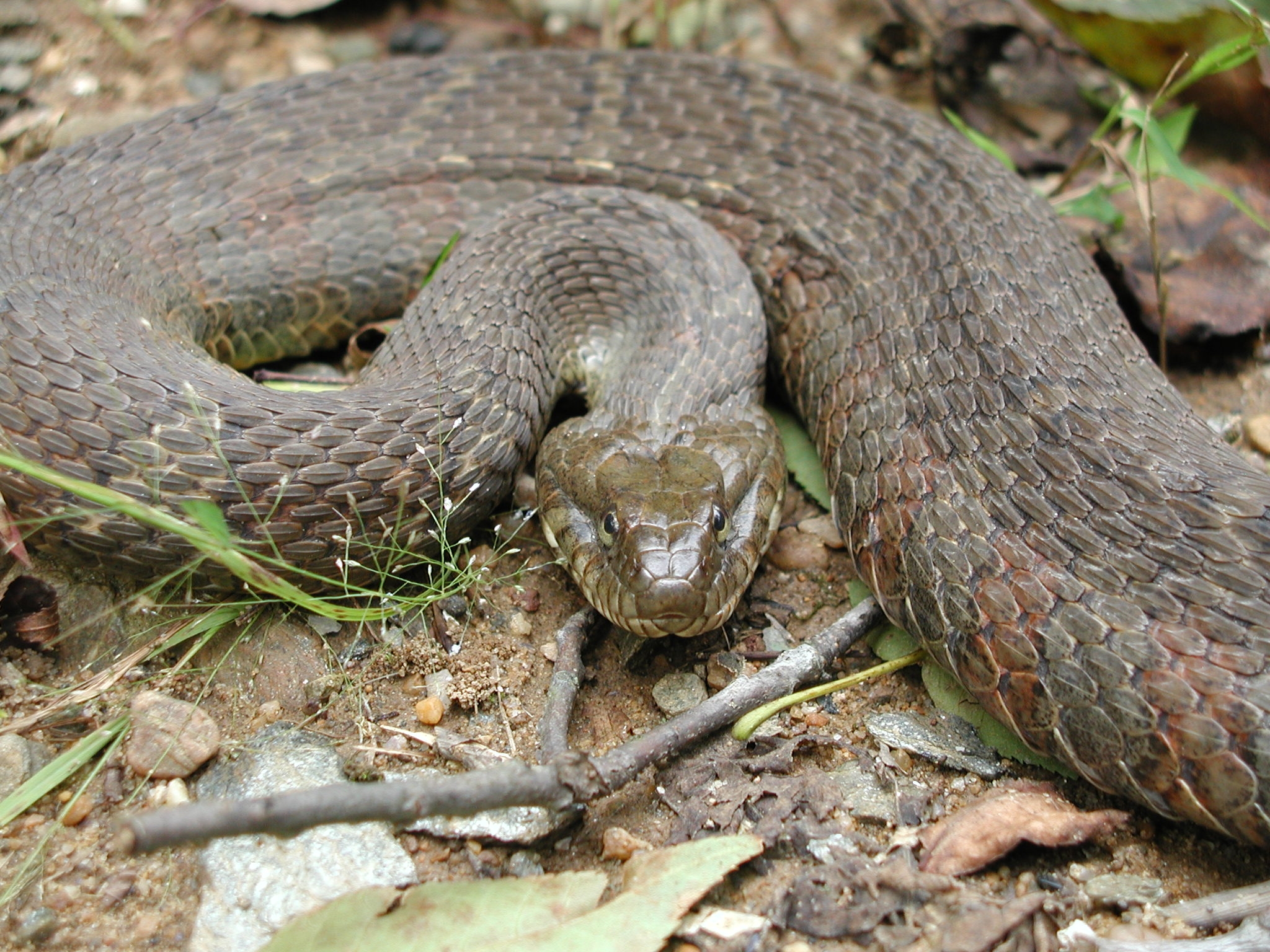
Every now and then while lifting rocks in search of newts and crayfish, I would expose a water snake tightly coiled in the muck. The northern water snake closely resembles the venomous water moccasin (or cottonmouth) down to the viper-like shape of its head. Indeed, herpatologists would strongly recommend not getting bit by a northern water snake because, notwithstanding the bacterial load of its saliva, the northern water snake,, along with the widely abundant garter snake,  may be in the early evolutionary stages of developing a functional envenomating delivery system. In other words, they may be half-assed venomous! Plus, the northern water snake secretes a foul-smelling musk when alarmed. Is it any wonder that I was almost unbearably intrigued with trying to catch water snakes?Incidentally, the method I employed in the capture of these and other large snakes was the classic “pin-the-head-and-secure-by-the-neck” technique. Speaking as someone who’s been bitten at least twice by northern water snakes, I would urge you not to put too much faith in the “pin-the-head-and-secure-by-the-neck” technique.

I can report that with advancing age (and declining reflexes) I have become less a player and more a spectator in nature’s grand pageant. What I wish I could also report is that I’ve become adept at identifying the various flies that constitute important parts of the trout’s diet. Unfortunately, no matter how voraciously trout are rising to a hatch, I hardly ever see anything flying near the water or off the water, for that matter. I’ve watched videos of anglers plucking flies from rocks or picking them out of mesh nets. Yet they elude my eyes. If I have to restrict my nature watching to things chickadee-sized or larger, so be it.

I’m not going to lie to you, though. The hardest thing for me to come to terms with, as you might have guessed, is reconciling the kid who seemed able to go anywhere and do anything he willed, to the man who would gladly trade an abundance of time to reflect for the ability to slip on a pair of waders and get knee-deep in the water.


,


\


Spring Coulee (Part II)

There is one way to get in or out of  Coon Valley: State Route 14, which you pick up right outside of Madison, Wisconsin. S.R. 14  will take you through the towns of  Cross Plains  and Black Earth, through which flows the legendary Black Earth Creek. You will pass through Spring Green, site of Frank Lloyd Wright’s  iconic Taileson Studio; and Richland Center, the actual birthplace of Frank Lloyd Wright. You will notice that the landscape is changing — dairy farms, corn fields and gently sloping pastureland giving way to hills, bluffs and promontories as the road begins rising and falling like a roller coaster writ large.

After passing Amish farms with white, unadorned  houses and surprisingly large barns topped with windmills, you will drive into Viroqua , where the stewards of those farms — disconcertingly urbane Amish wheeler dealers — are selling fresh produce, honey, balms, elixirs  and scented soaps at the Farmer’s Market. The black carriages that brought the Amish vendors into town are arrayed in a neat row in the adjoining alley while the horses, tethered to the carriages, eat from feedbags strapped to their necks.

Leaving Viroqua, you continue on to Westby, where a fair portion of the signage is in Norwegian. Just past Westby, Rte.14 begins its slow 9-mile descent into Coon Valley. During the course of this drive you may see wild turkey, white-tailed deer, coyotes, bull snakes seeking warmth on the pavement, and the occasional small, fleet-footed critter — weasel? marten? mink? — that appears as a blur in your peripheral vision and then leaves you mildly awe-stricken with the realization that you have been blessed with a glimpse (or was it just your imagination?) of something wild and elusive.

About the time you start feeling a touch claustrophobic by the dark, pine-covered ridges rising on either side of the road, you will round one more sweeping bend and then you will break into sunlight. Your first vista will be of a russet church steeple, peeking above a canopy of maple trees. When you’re down in the valley proper you will come upon the church cemetery, where every detail, from the red geraniums resting on polished marble grave markers, to the knee-high filigree, wrought-iron fence girding the cemetery, is straight out of Central Casting’s Department of Americana.

Next, you turn onto County Road P and pass several neat, wood framed houses, and just like that, you will be back in the country, trying to keep pace with speed limit signs that increase or decrease by 10-to-20 mph seemingly every 50 feet . You slow down when you catch sight of the sign announcing “Spring Coulee Public Fishery” because you remember that Spring Coulee Road is s an inconspicuous turnoff just beyond the sign and almost at. the point where County Road P makes a broad sweep southward with a vista featuring dramatic bluffs. It’s easy to imagine how someone unfamiliar with the area could overshoot the turnoff while marveling at the scenery.

You’ve finally made it! Spring Coulee Creek cuts from one side of the road to the other in switchback fashion — broad, quiet pools alternating with stretches of dancing riffles.  Paul Kugat’s  house is just up the road.

I’m at Paul’s “golden pool,” a stretch of  Spring Coulee that runs slow, broad and deep for nearly 75 ft. thanks in part to reinforcements of rock fill  and wood bracing, courtesy of the Wisconsin Department of Natural Resources. Any hatch or related aquatic event happening anywhere on the 4.5 miles of water constituting Spring Coulee Creek, likely will be happening in the Golden Pool.

What I’m observing are trout responding to some  manner of hatch. It’s April 26, the weather’s sunny, the water temperature is 52 degrees F. The logical hatch should be tan caddis flies, which would be right on the seasonal timetable. But I’ve also observed fish jumping clear out of the water, which suggests they’re feeding on ahead-of-schedule crane flies, notable for their tendency to hover several inches above the water.

I’ve tried both crane fly and caddis patterns to no avail. Still, the feeding activity continues, nothing dramatic, but steady. This is immensely heartening because upon arrival a couple of hours earlier, I couldn’t even get one cast  off before I sustained a “mishap,” my euphemism for when I notice in preparation to casting or upon casting that part of the picture is not as it should be — for instance, my leader is looped around my rod; or my fly has caught on my pants leg; or my fly line has affixed itself to one of the Velcro strips on my vest. The perverse beauty of a mishap is that it almost always presents to clear choices: You can be Gallant (who remembers Highlights for Children magazine?), and calmly invest the 20 to 30 seconds needed to  unwrap the leader or free the snagged fly, etc.;  or you can be Goofus, and proceed to “shake” free the looped leader, “whip” the snagged fly free, or “accept and subsequently work around” the affixed Velcro strip.  Considering that the raw materials of angling include, among other things, hair-thin monofilament line and a barbed implement designed specifically to penetrate things and not come out, why in the world haven’t I learned that going the Goofus route is guaranteed to transform a small problem into a big problem, with the added bonus of new, wholly unanticipated wrinkles, or, as I like to put it, “Are you friggin” kidding me?”

The particular mishap with which I grappled is the bane of all fly casters–  the snagging of your fly during the back cast.

The proper strategy  prior to casting is to ensure that you have an unobstructed casting lane, both behind and in front of you.. But even when I’ve been on top of my game, I’ve struggled to hold my eagerness at bay when a hatch is on. In this particular instance, I got off a respectable back cast,  which, had its forward progress not been impeded by a willow branch, would have shot over the pool and made a soft landing inches from the still visible ripples where a trout had just sipped a juicy morsel. Instead, I was forced to contemplate my size-18 tan caddis emerger lodged about  eight feet behind me and, oh, maybe ten feet  overhead. A bummer, to be sure, but I probably could have bent the supple willow low enough to free the fly, and then proceed to make another cast.

Instead, I repeatedly whipped my rod to and fro, lodging my fly even more securely into the willow until my tippet finally snapped. This time I wisely opted to simply tie on a new leader,  but in my haste to uncoil the new leader, I snarled the hair-thin tippet at the terminal end, effectively rendering the leader useless. So what perverse impulse compelled me to attempt to unsnarl the leader rather than simply grab another and take better care in uncoiling it?  Because the hatch was on and I needed to get a fly on the water ASAP. Needless to say, opting instead to unsnarl a bird’s nest of tippet already knotted in several positions is what we in the teaching profession refer to as a “poor choice,” tantamount to a student choosing  to fire up a blunt while his teacher is urging hi to focus on his test.

When I finally threw in the towel and tied on a third leader, I was stunned to see that the hatch was still on. But, as I alluded to earlier,  I couldn’t figure out exactly what the trout were rising to. One big problem was that, since my stroke, I no longer had the mobility and balance to get into the water, which would enable me to drop my fly in places I couldn’t access from shore. Nonethes I attempt to tie on a size-16 crane fly.

“Screw it,” I mutter, after I realize that I seem to have lost the ability to tie a small fly in the falling light. I tie on a larger crane fly, and, putting my rod aside, I lay back in the corn stubble and contemplate the place I  have traveled 270 miles to reach. One thing is sure, I think. No sound beats the burbling of water over rocks. Barn swallows buzz the pool, periodically swooping to snatch from the surface film whatever is hatching. I close my eyes and begin drifting off, but I am soon nudged awake by Paul’s dog, who after reacquainting his nose with my body odor, presents his head for a pat.

Paul can’t be far behind, I correctly predict.  “Good to see you, Tom.”

“Hey Paul,” I reply.  I struggle to get on me feet.

“No, no,” he implores. Stay right where you are.” With a grunt, he drops beside me.

“It’s always such a pleasure to see you, Paul says, clasping his hand in mine. At that moment, a distinct “whump!” resonates from the pool. ” I think I know that fish,” Paul says.

I smell a “fish story” coming on. The thing about Paul’s fish stories, though, is that their credibility is reinforced not only by the hundreds of hours he has devoted to studying every nuance of his stretch of Spring Coulee Creek,, but also by his propensity for keeping detailed notes..

“A big storm blew through the valley two weeks ago,” Paul says. “Everything  was under water almost to the steps of the house.” (Paul’s house sits on a terraced ridge about 20 feet above the stream). “But the real impact of the storm was it actually reconfigured the stream. The gravel bed that ran along the inside channel was swept away. That was prime spawning habitat.” Paul gazes wistfully at the pool.

Whump!

“That old girl’s honing in on crane flies,” Paul observes.

“I take it that’s a big trout,” I venture.

“I’d say eighteen inches, at least, Anyway, that storm carved out the channel, upstream and downstream. There were a couple of days when all the trout in this pool were swimming around in the corn field. Then when the water came down and the trout came back, they found a pool that was way different from what it was.”

I mention that the feeding activity did seem to emanate from unexpected parts of the pool.

“You’re absolutely right,” Paul says. “This time last year, there would be five or six nice trout lined up along the crib I put in at the bend. Now there’s just one big trout,probably blew down in the storm.  If you get up on the bridge (spanning the creek just above the pool), you can probably see it.”

Pre-stroke, I would have dashed to the bridge, checked out the monster trout, and then dashed back to the pool, eager to try my hand at catching it. But that was then. The sad truth regarding “now” is that I have expended my energy trying to undo the mess I made when I had first arrived at Paul’s pool. Suddenly, I have a dispiriting revelation: There’s no doubt in my mind that once I get back on my feet, I’m going to call it quits and head to the car.

Paul, bless his heart,probably also realizes that I don’t have the stamina to hike the fifty or so feet to the modest foot-bridge, so he tactfully switches gears, inquiring about Suzanne and the kids. But then,

Whump!

“She’s really going to Town,” Paul observes and suddenly I am gung-ho to stalk that trout  – in my mind, at least . Physically, I am still out to lunch.

I turn to Paul, “Take my rod, See if you can get it.”

“I’d love to see you get it,”.

“I don’t have the range or the accuracy,” I protest, “but I know you do.”

I:could see that Paul is flattered. In truth, he is the best caster I know.

“You sure?”

“I insist.”

Paul takes my rod, steps carefully into the water, soaking his pants nearly to the knee, and then stands motionless. “Talk to me,” he beckons.

Whump!

“Gotta be crane flies,” he calls to me. “what luck!  You got one tied on.”

Paul makes two false casts and then shoots the line forward letting it glide between the thumb and forefinger of his non-casting hand. The fly looks like it might land on the opposite bank, until, with the slightest flick of his wrist, Paul halts the fly’s trajectory and drops it exactly where it needs to go.

Kabluump! Just like that, Paul is holding his rod high over his head,”Whoa, she’s big” he shouts. The trout clears the water, looking like a brown torpedo. “Oh no you’re not,” Paul mutters as itstart s swimming toward the  far bank. “She’s heading back to the crib and there’s not a friggin’ thing I can do about it!”

True to Paul’s prediction, what my “floating” fly line begins sinking. When the it reaches a depth of two feet, it stops moving. Paul slowly tightens the line, presumably to gauge how the trout might respond. The line becomes taut and then suddenly goes slack. “Really?” Paul mutters sarcastically. With remarkable calm, he reels in the line. “Check it out,” he says with surprising tact. “She didn’t break the line. She just pulled the hook off the line.”

I had tied a shitty knot.

“She’s probably not going to be that easy again,” Paul says, philosophically. “But one of us will get her, eh?”

Paul drapes his arm around my shoulder. “You coming back tomorrow?” he asks.

“I might get an early start home,” I reply.  “They’re talking about rain and all.”

I hope to see you!” Paul exclaims. “And please tell Suzanne, not to be a stranger!

By nine o’clock the next morning, I am on my way back to Evanston. The weather is gorgeous.

Spring Coulee (Part I)

I’m writing this post Thursday evening, May 7, 2015,  in front of “The Daily Show” with Jon Stewart. Last night, Lebron James and the Cleveland Cavaliers beat Derek Rose and the Chicago Bulls in Game 2 of the NBA  semifinals  as decisively as the Bulls had beaten the Cavs  in Game 1.  This inglorious loss has forced upon me the  bleak revelation that not only will my beloved Bulls, even with Jimmy Butler and a supposedly healthy Derek Rose, not be taking Chicago to the mountain top, nor, in all likelihood, will the Cubbies,

Given the circumstances, I’ve decided to do the one thing that I know will soothe my angst-ridden soul —  I will drive to Coon Valley, Wisconsin. This will put me into the heart of the Driftless Area, the home of Paul Kugat. Were it not for this kind and generous man, I doubt that I would have fallen in love with fly fishing, and I certainly would never have discovered  my all-time most-enchanting little pocket of paradise on earth (excluding, of course, any time I’m wrapped in the arms of my beloved wife, Suzanne) — the quarter-mile of Spring Coulee Creek that flows along Paul’s property.

The Driftless Area area comprises about 16,000 square miles, mainly in southwestern Wisconsin, but also extending into southeastern Minnesota and northeastern Iowa.  The Ice-Age glaciers missed this part of the Upper Midwest. The downside is that this part of the upper Midwest lacks the 10-to-12-ft. overlay of the rich topsoil characteristic of most of the lower Midwest. The upside is  natural beauty expressed as deeply carved river valleys through which flow hundreds  of miles of spring-fed streams (or “coulees,” as the French called them) rich with brown and brook trout.  Imagine a pristine, sun-spackled brook meandering through gently rolling pastureland against a backdrop of rugged, wooded hills, and you have the quintessential Coulee Country postcard.

Coon Valley is a town of about 700 straddling Vernon and Lacrosse Counties. Within 15 minutes’ drive of Coon Valley are the following world-class trout streams: the aforementioned Spring Coulee,  Rulland’s Coulie, Bohemian River, and Timber Coulie, which by some counts, has more native trout per 100 feet of water than any stream in the nation. These are spring-fed, limestone Creeks notable for the amazing abundance of caddis fly, may fly, crane fly, and stone fly larvae; along with “scuds,” small, shrimp-like creatures, and numerous other aquatic invertabrates. Because numerous  underground springs feed into the creeks, the trout grow fat feeding well into the winter (due to the moderating influence of the springs) on an abundant, varied diet.

And of course, all those fly larvae undergo metamorphosis and emerge as adults throughout the spring and summer in impressive hatches, driving trout into a feeding frenzy. Every time I drive to Coon Valley, it is with the anticipation that I will, a): stumble into a hatch; and, b):figure out which bug the trout are feeding on. Of the 70 or so trips I’ve made to the Coulie creeks, I’ve lucked into and “solved” hatches maybe 15 times.  However, since my stroke, I’ve been to Coon Valley at least a dozen times, and although I’ve seen hatches,  I’ve only managed to hook and land seven trout.

I’m turning off Spring Coulee Rd. descending down the hill to Paul’s property, where I hope to answer a pressing question: Given my state of physical impairment, can I still catch trout on a fly, even on the exquisite, fly-casting friendly pools and riffles of Paul’s stretch of Spring Coulee Creek?

Image

Take a kid fishing

I remember a student back when I taught at the Jewish Child & Family Services Therapeutic Day School (let’s call him “Allen”) who was a 13-year-old, 220-lb. kid with duo BD behavior disorder) and ED (emotional disorder) diagnoses, along with the newly trendy label of ODD (oppositional/defiant disorder). On top of that baggage, by virtue of his history of assaulting teachers.  Allen was saddled with a third label, one not recognized by the DSM (Diagnostic and Statistical Manual of Mental Disorders), but one casually tossed around by teachers and social workers alike: conduct disorder.

Before I  talk about one of my all-time favorite students, could you indulge my insertion of a brief aside? School districts have been under the gun to ensure that students are placed in the “least restrictive environment” (aka the mainstream general-education classroom). Some students (but only after months of observation and numerous failed interventions) are deemed too disruptive for the mainstream classroom setting, at which point they are  moved to a more restrictive tier — the self-contained classroom. The next tier for students unable to thrive in the “small, structured  environment” of the self-contained classroom is the therapeutic day school. ( It’s worth noting that what would be a perk in the eyes of some TDS students — that they will be picked up and dropped off at home every day by bus — is a curse in the eyes of other TDS students — the busses are typically the “short,”  yellow ones).

Meanwhile, the handful of students whose behavior cannot be contained even in schools staffed with 8-to-12-member “crisis teams,” may find themselves staring into the maw of the final tier–  the residential day school (aka  “hospital school”) or the residential detention school (aka “juvie school”).

Regarding Allen, I pretty quickly realized that what he had  to offer was a formidable intellect, an insatiable curiosity, an ability to respect, even defer, to adult authority figures, and an endearing desire to please. The only thing Allen asked in return was to be treated with respect.

Given the power imbalance inherent in the teacher/student dynamic, students tend to have finely honed observational skills (aka “bullshit-detection radar”).  I flew under the radar, so to speak, because the vibe I projected to students was along the lines of, “I don’t deserve the privilege of teaching you because, frankly, I don’t think I’m a very good teacher.” This seemed to project the encouraging message that I was “real,” and hence, worthy of my students’ respect.

My conduct and composure in the classroom certainly seemed to strike Allen’s fancy. By my second day as his instructor he was punctuating my lessons with commentary such as “Cool,” and “You’re awesome.”

Alex1

Like many inner-city kids, Allen was a nascent “nature nut,” eager to seize any opportunity to escape the concrete and diesel fumes of his block for wide-open spaces lush with novel sights, sounds and  smells.

At some point, probably late October 2008, I asked Allen if he had ever fished.

“You mean with a fishing pole at a lake or something like that?”

The expression on his face was one I’d seen before.  An authority figure drops something tantalizing  on an already beaten-down kid that has the potential to be very good, but which could also be some sort of trap or prank.

“I’m thinking about putting in a request for a fishing field …”

“I’m in!” “I’m in!” “I’m in!” classmates Adrian, Chris, Jonathon, Amanda and Kevin volunteered before I could complete my sentence.

This was the reassurance Alex was looking for. “Me too!”

Intrigued by the novelty of a fishing field trip, the first such outing in the school’s history, my principal gave the okay. However, between the in-school and out-of-school suspensions served by one or the other of my students, it wasn’t until May that all six of them were good to go.

Our destination was 17-acre Axehead Lake. Located in Park Ridge (about a 25-minute drive from the day school, Axehead is by far the most consistently productive Forest preserve lake I’ve fished. It is stocked with rainbow trout every April and October, but it’s the lake’s healthy bass and bluegill population that keeps me coming back.

The moment I pulled into the parking lot and noticed that the lilacs fringing the southern lake shore were in full bloom, I was certain that we would catch fish.   I brought along  five spincast  and two spinning rigs. Dave, my classroom aid, contributed two more rigs. I also sprung for four- dozen wax worms, a bait that bluegills find irresistible. Bearing a vague similarity to maggots, these plump morsels are about three times the size of maggots and about 90-percent less disgusting.

Another key attribute of waxworms is that if you run a hook into the head and through the  body to the “tail,” bluegills will rarely succeed in stripping off the bait. I expected Axehead’s  bluegills to accommodate even the first timers in our crew by “self-hooking.” Thus, I would be able to bait one angler’s hook while reminding another angler that her grape-sized bobber was making figure eights out on the water.

Back at the school, my students could charitably be called “high energy.” Here at the lake  they practically stood at attention as Dave and I  briefed them on lake etiquette, that is, until Allen took a glancing hit from one of the legions of cicadas that chose this sunny spring day to heave their 17-year-old selves out of the earth, shuck their grubby bodies and  take wing for two days of seeking mates while colliding with every stationary object they encountered.

“They have evil eyes!” Allen shrieked before running around in circles, furiously swiping at both real and imagined cicadas.

“Their favorite color is red,” Jonathon deadpanned as Alex cast a desperate look my way.  That was a nugget of science lore I could neither confirm nor deny, I acknowledged sheepishly.

We were finally able to mollify Allen by forming a “human shield” around  him, batting away any cicada foolhardy enough to attempt a breach of the perimeter. The “emergence event”  did not abate, but fortunately, Allen’s fear of “alien bugs” couldn’t hold a candle to his desire to get his hands on one of the fishing rods. In short notice, Allen was at the bank, hoisting 5- and 6-inch ‘gills, while Dave or myself  unhooked them and threw them back. ( I had discouraged Allen and his classmates from keeping fish they weren’t prepared to clean, cook and eat.)

Each of the students caught at least one fish. Jonathon even caught a nice half-pound largemouth bass.  Three factors — the full sun, Allen’s re-emerging cicada-phobia, and the need to get back to school in time for the departing buses — compelled us to do the unthinkable: walk away from a lake where the “bite” was still going full throttle. The one compensation was that we had factored in enough time to spend the $40 “food allowance allocated for the trip. Hello Whopper Juniors!

.